How Google Maps Chooses Which Local Businesses Show Up First (Plain-English Explanation)
Wondering why competitors outrank you on Google Maps? The plain-English breakdown of how Maps picks local businesses — and what to fix first.

You open your phone, type “plumber near me,” and watch your competitor sit at the top of Google Maps while your own listing is buried below the fold. Same city, same service, but they get the calls.
It feels random, like Google is picking favorites. People tell you to “just blog more” or “post on social,” yet your phones stay quiet while the Maps 3‑pack keeps feeding your rivals.
This guide breaks down google maps business ranking in plain English so you can see how Google decides who shows up first, why your competitor might beat you, and what to fix in the next 30 to 90 days.
How Google Maps Really Chooses Who Shows Up
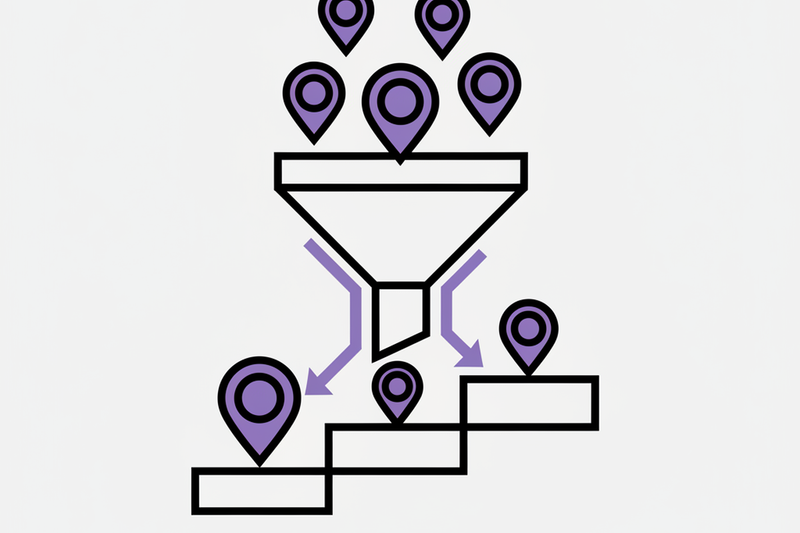
When you wonder how does Google Maps choose which businesses show up, Google is not rolling dice. It scores local businesses on three main buckets, which Google itself calls out in its own local ranking help article: relevance, distance, and prominence.
Think of it like a referee using three scorecards. Your total score across those cards decides whether you land in the Map Pack or sit on page two.
Here is the simple version:
Two important truths to keep in mind:
- Results are personalized by location and device, so there is no single “number one” spot for every person.
- You still have plenty of control, because relevance and prominence are mostly your doing, not Google’s.
The rest of this article shows you how to move those two levers first.
Relevance: Does Your Profile Match What People Search?
Photo by Lara Jameson
Most local buyers type “service + city” and then tap someone from the Map Pack. If your Google Business Profile (GBP) does not line up with those money terms, you lose before reviews or links even matter.
Relevance is where Google checks “Are you actually what this person wants?”
Key parts of relevance you control:
- Primary category: This is huge. “Plumber” versus “Bathroom remodeler” sends a very different signal. Pick the one that matches your core money work, not the one that sounds fancy.
- Additional categories and services: Add real services you sell, like “emergency plumber” or “wisdom tooth extraction.” Do not stuff every idea you can think of.
- Business name and description: Use natural language that covers your main services and city, without spammy keyword stuffing.
- Photos, products, and Q&A: These help confirm what you do. If you install fences but every photo shows interior painting, Google and humans both get confused.
Many owners obsess over blog posts while their GBP is half filled out. That is backwards. Industry tests, like this guide to GBP ranking factors, keep showing GBP as the primary signal for Map Pack visibility.
You want Google to look at your profile and think, “This is the clear match for ‘[service] [city].’”
While you're at it, take a look at our guide on our GBP optimization checklist.
Proximity: Why The Closest Shop Often Wins
It's also worth reading our take on strategies for getting more Google reviews if you haven't yet.
Proximity is the score you control the least, but it explains a lot of “why are they outranking me” moments.
For “near me” searches, Google favors businesses close to where the search happens. A solid but slightly weaker competitor that is two blocks away can beat a stronger business on the other side of town.
A few practical points:
- Your real address anchors your visibility, even if you set a wider service area.
- If you moved and never fixed your address across the web, you confuse Google and can hurt both proximity and trust.
- Trying to “fake” locations with virtual offices or P.O. boxes is a fast track to suspension.
You cannot cheat distance, so the smart move is to own your neighborhood first. Aim to be the default pick for searches within a short radius of your real address, then build wider prominence over time.
Prominence: Reviews, Website, And The Rest Of Your Footprint
Prominence is where you can make the biggest gains. It is Google’s way of asking, “Is this business well known, trusted, and active?”
Several ingredients feed this score.
Reviews: Ranking and conversion in one
Reviews are not just social proof. They help both where you rank and how many people pick you.
Signals that matter:
- Total review count
- Average star rating
- How recent the last reviews are
- Words people use in reviews (your services and city)
- Your replies and tone
We see it all the time. A med spa that increased its rating by about one star and doubled its review pace over 90 days also doubled bookings. Nothing fancy, just a simple “Review OS” with clear requests, reminders, and reply templates.
If you do one thing this month, set up a simple flow:
- Ask every happy customer by text or email.
- Send one polite follow‑up.
- Reply to every review with short, personal answers.
Website and content
Google cross checks your GBP with your website. Service pages that clearly say “roof replacement in [city]” or “family dentist in [city]” help relevance and prominence at the same time.
External studies like this Google Maps ranking factor guide keep showing that strong on‑page local content and a healthy link profile help both organic and Maps visibility.
You do not need a huge blog. You do need:
- A solid home page that names your city and services
- Individual pages for your main services
- Clear contact details that match your GBP
Citations and NAP consistency
Citations are your business listings on sites like Apple Maps, Bing, Yelp, and industry directories. Google uses them to confirm that your name, address, and phone (NAP) are real and consistent.
A one‑time push to build about 30 to 40 high‑value listings, plus cleanup of old or wrong ones, is usually enough. You do not need to pay a big monthly fee forever just to keep your address the same.
Behavior in Maps
Finally, Google watches how people interact:
- Do they tap your listing more than others?
- Do they call, visit your website, or request directions?
- Do they bounce back right away?
Better photos, clear offers, and accurate hours all nudge those signals in your favor. Over time, that can move your position in the Map Pack.
Why Your Competitor Shows Up First
When a competitor keeps beating you in Google Maps, it is rarely one magic trick. It is usually a small edge in each of the three buckets.
Common reasons they win:
- Their address is slightly closer to where searches happen most.
- Their GBP categories and services match money terms better.
- They have more reviews, fresher reviews, or better replies.
- Their website backs up the profile with clear local pages.
- Their citations are cleaner and more consistent.
A simple way to spot your gaps:
- On your phone, search your top “service + city” terms and screenshot the Map Pack.
- Open your competitor’s profile and your own side by side.
- Compare categories, services, photos, posts, reviews, and Q&A.
Pick three specific gaps to close over the next 60 to 90 days. For one home‑service client, tightening GBP, review flow, photos, and core citations took them from about position nine in Maps to position three in roughly two months, and calls jumped by around 38 percent.
Same city, same service, different operating system.
What To Do In The Next 30 Days
You do not need a PhD in SEO to move your google maps business ranking. You need a short, repeatable plan.
Here is a simple 30‑day playbook:
- Week 1: Fix your GBP basics. Correct categories, hours, services, description, and contact info. Add at least five strong photos.
- Week 2: Launch your review flow. Start asking every happy customer and replying to every review.
- Week 3: Post once on GBP each week. Share an offer, a recent job, or a helpful tip tied to your services.
- Week 4: Claim and correct major listings so your NAP is the same everywhere.
Then keep the cadence going. Local SEO rewards steady signals, not one‑time stunts. Track calls, forms, and direction requests from Maps, not just where you sit for one keyword.
If you want to own your neighborhood but do not have time to run this yourself, you can hand it to a done‑for‑you Local SEO operating system that focuses on GBP, reviews, media, and citations. Either way, the goal is the same: a stronger Map Pack presence that turns more searches into real‑world jobs.
If you're working through this, our how local citations work for service businesses post walks through the details.